… after a few years limping on, I’ve now fully given up the allotment. Seems daft to continue with 18 Saughton Mains as a blog title, so I’m moving to Alex in Shandon.

… after a few years limping on, I’ve now fully given up the allotment. Seems daft to continue with 18 Saughton Mains as a blog title, so I’m moving to Alex in Shandon.
If only I had re-started learning Italian earlier, I might have had the drop on the exploding artichoke story
I’ve stopped leasing the allotment, so I’ve gained plenty of time where I used to work on that. And as New Year is a time for resolutions, and the more the better, I may as well over-commit to things to do and see which ones stick…
Time lapse map of every nuclear explosion ever on Earth
Map that onto the permanent members of he UN security council…
The Scottish independence debate should be framed in terms of what will lead to more local decision-making and a more active democracy; it’s viewing independence as a tactic to gain more local control rather than treating independence as a strategic goal. And so I’m pleased to see Unison Scotland’s A Fairer Scotland report which starts by defining the positive characteristics we want for a society, and argues that these should be debated first to give us a way of choosing between the referendum options.
The characteristics Unison defines makes me pleased to be a member of that union.
And I’m still not voting for the union. I’m undecided, in the sense that it’s Yes or a spoiled ballot paper for me.
As an addendum, here’s a link to the Christie Commission report that’s quoted in the Unison document.
Just signed up to this year’s Fife Diet AGM, Food solutions. I really enjoyed going to last year’s event, so looking forward to this one and here are some notes from last year’s event.
After the worst year yet on the allotment, I’m giving up half the plot. Feeling a bit dejected about that but today I was there and looking at the half plot, and thinking that it’s a more manageable size.
The South side is the one with the shed I fixed earlier in the year, and has the best-developed beds. I’ve been moving as many plants as I can on to this side before the North side is reallocated but there are plenty of plants still on the North side that I’ll leave: an apple tree, a redcurrant, some Autumn raspberries. And today I had to make a decision. I’ve only got one bed clear on the South side and I had to choose whether to move some Summer raspberries or some rhubarb. I can’t imagine I’ll have another chance to prepare a bed and move the other before the plot is reallocated, hence decision time.
I chose rhubarb.
In the end it wasn’t a difficult decision: rhubarb comes up earlier in the year and there’s more bulk from the plant, so it’s a sensible decision. But I feel a little sad that I won’t have raspberries for the next couple of years until I sort my new half-plot out. There’s something so good about picking a couple of warm raspberries when down the allotment… That would have been the heart decision.
Does the Tao Te Ching talk about endurance running when it states “He who strides cannot maintain the pace”? Angus Farqhuar’s orientation talk for runners at the start of NVA’s Speed of light certainly did, and his assertion that most of the running would be at a medium walking pace proved true. What we didn’t see from the tent was the enormity of the hill, nor how steep some of the sections were. But in the end, the red route never went straight up the hill on the steepest paths, the training paid off, the weather was fine and everyone in the group buzzed across the hill.

Tents from Haggis Knowe
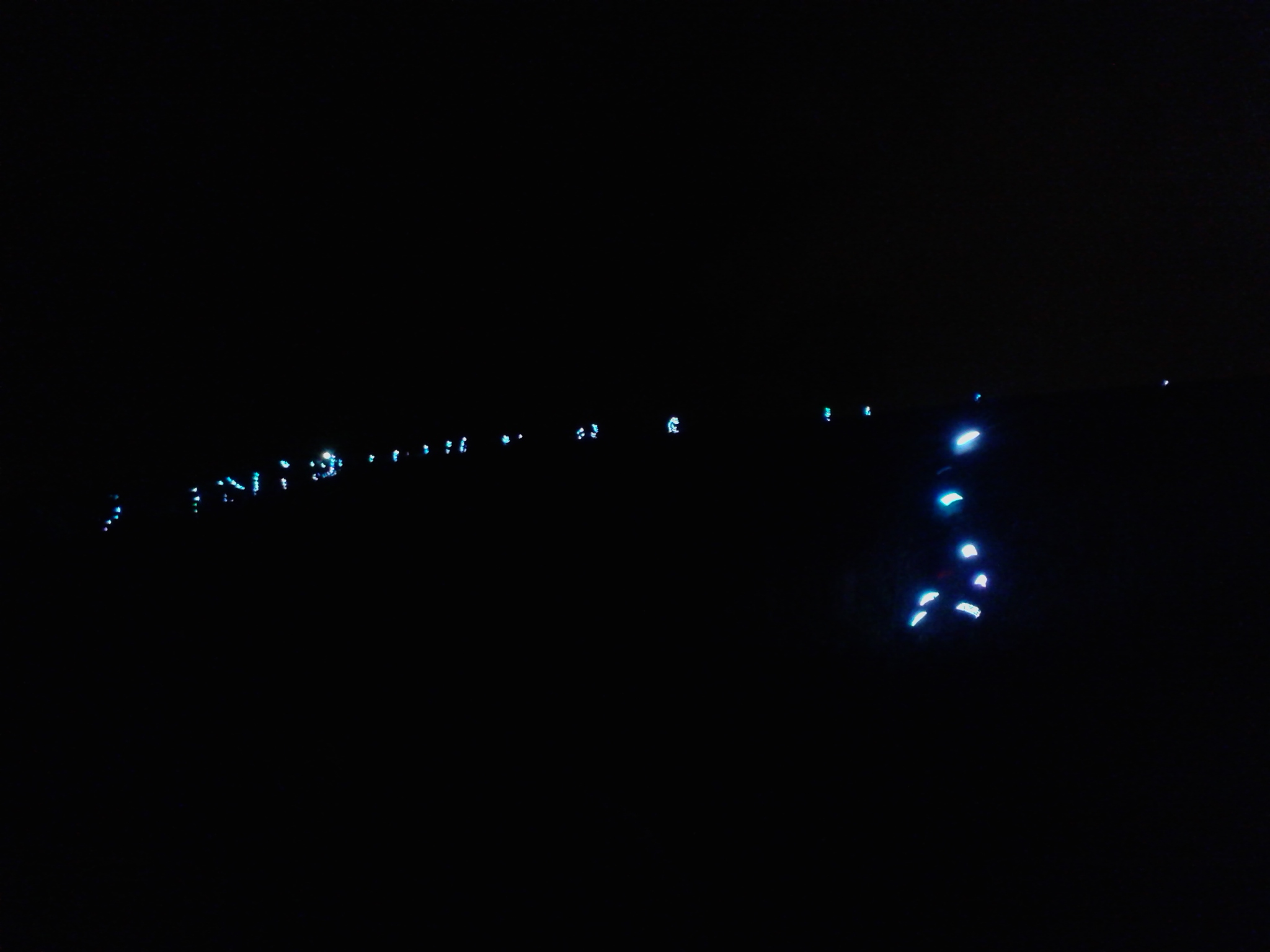
Dots of light on the hill
Running along the A route along the top of the crags was fun, but the most spectacular parts were when all the groups converged to one of the hubs. Towards the end, the red group were the furthest (stage) left and we got a great view of the constellation: when the lights suits went off and every runner turned into a twinkling light.

In a hub
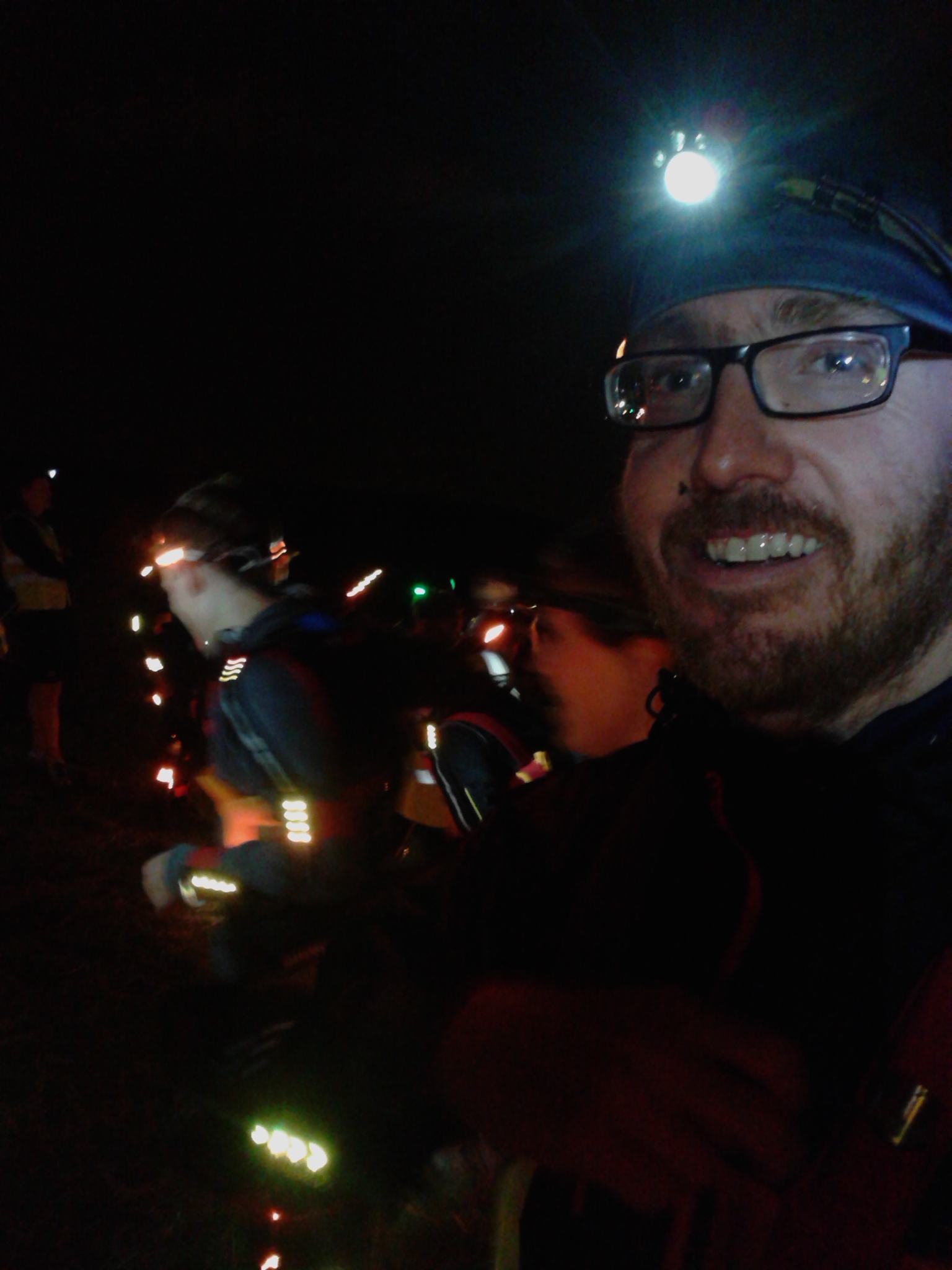
Stephen, the hill runner

Me, at the end of the night

Coming back to the tents
Supported by our two run leaders, the hour and a half went quickly. Then back to the tents and a cycle home through the rain.
Here’s the full stanza, just for completeness. We did make a show and, even if we didn’t become enlightened, at least we were lit up.
He who stands on tiptoe is not steady.
He who strides cannot maintain the pace.
He who makes a show is not enlightened.
He who is self-righteous is not respected.
He who boasts achieves nothing.
He who brags will not endure.
According to followers of the Tao, “These are extra food and unnecessary luggage.”
They do not bring happiness.
Therefore followers of the Tao avoid them.
Tao Te Ching, stanza 24.
… and following on from the previous post on education, I can’t quite believe that Billy Bragg’s To have and to have not is almost 30 years old. It’s still valid; still resonates strongly.
Up in the morning and out to school
Mother says there’ll be no work next year
Qualifications once the golden rule
are now just pieces of paper
Just because you’re better than me,
doesn’t mean I’m lazy.
Just because you’re going forwards
doesn’t mean I’m going backwards.
If you look the part you’ll get the job
in last year’s trousers and your old schools shoes.
Truth is, son, it’s a buyers’ market
they can afford to pick and choose.
Just because you’re better than me,
doesn’t mean I’m lazy.
Just because I dress like this
doesn’t mean I’m a communist
The factory’s closing and the army’s full
I don’t know what I’m going to do
Well I’ve come to see in the land of the free
there’s only a future for the chosen few.
Just because you’re better than me,
doesn’t mean I’m lazy.
Just because you’re going forwards
doesn’t mean I’m going backwards.
At 21 you’re on top of the scrapheap;
at 16 you were top of your class.
All they taught you at school was how to be a good worker.
The system has failed you; don’t fail yourself.
Just because you’re better than me,
doesn’t mean I’m lazy.
Just because you’re going forwards
doesn’t mean I’m going backwards.
The current system was designed and conceived for a different age: in the intellectual culture of the enlightenment and the economic circumstances of the industrial revolution.[02:06]
 18 Saughton Mains, no more!